


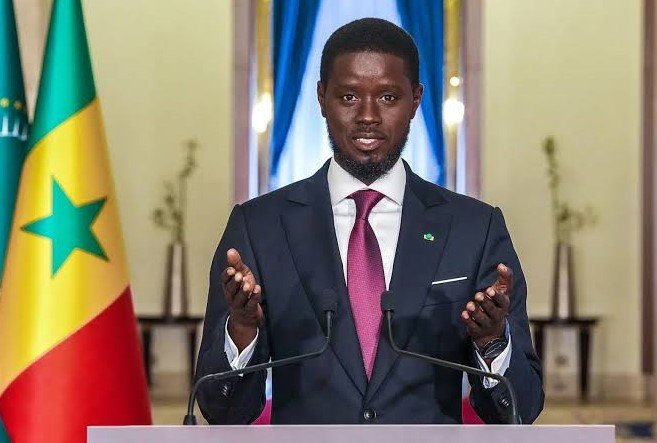
A court in Senegal has sentenced three TikTok influencers to prison over social media posts deemed insulting to President Bassirou Diomaye Faye, a ruling that has triggered fresh debate over freedom of expression and digital rights in the West African nation.
The convictions come at a time of growing political tension following the widening rift between President Faye and his former ally, ex-Prime Minister Ousmane Sonko, leader of the ruling PASTEF movement.
The three influencers are reportedly linked to Feenal Digital, an online content platform widely perceived by critics as being sympathetic to Sonko.

Among those convicted, Mandoumbe Diop, popularly known on TikTok as Lamignou Darou, received the stiffest sentence. The court handed him a three-month prison term without suspension. Diop is the most prominent of the trio, with more than 500,000 followers on TikTok.
The court also sentenced Magueye Diaw, known as Oustaz Thiep, and Moustapha Ndiaye, popularly called Ndiaye Touba, to two months’ imprisonment each, also without suspension. In addition to their jail terms, both were ordered to pay fines of 500,000 CFA francs (about $800) each.
Defence lawyer Abdy Nar Ndiaye criticised the judgment, arguing that the content posted by his clients was intended as comedy and satire rather than criminal conduct.
According to him, the videos should have been viewed as entertainment rather than treated as offences warranting imprisonment.
Feenal Digital describes itself as a media platform that promotes government programmes as well as private-sector initiatives through social media, particularly Facebook.
The case has drawn widespread criticism from free speech advocates, who warn that criminalising online commentary could undermine democratic freedoms and discourage open political discourse.
The convictions also come against the backdrop of increasing political uncertainty in Senegal, where relations between President Faye and Sonko have deteriorated after the two leaders, once close political allies, went separate ways.
President Faye’s recent decision to establish his own political party has further deepened divisions within the country’s ruling establishment, fuelling speculation about the future direction of Senegalese politics.