


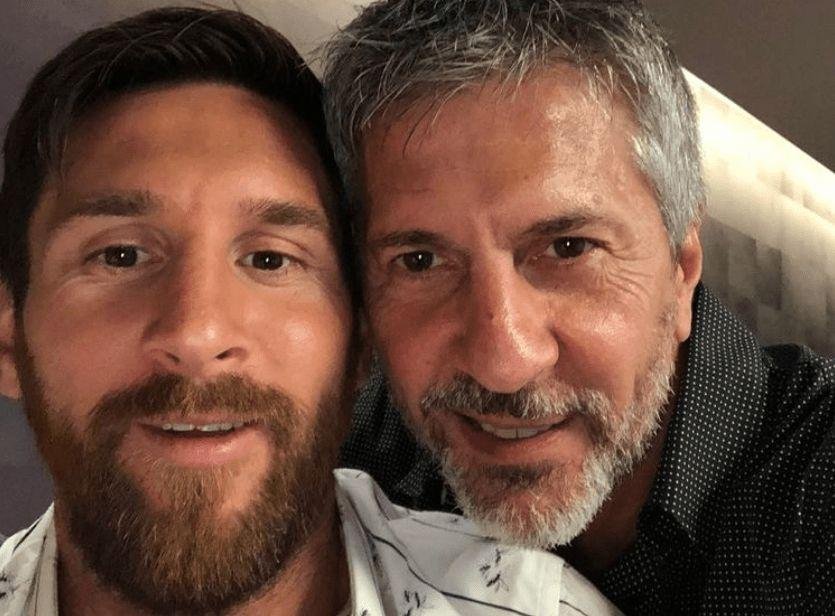
The death was reported by Spanish newspaper MARCA on Saturday, citing Argentine outlet Infobae. According to reports, Jorge died at about 10 p.m. on Friday at a sanatorium in Rosario, Argentina, following a prolonged illness.
Jorge was married to Celia Cuccittini, with whom he had four children: Lionel, Rodrigo, Matias and Maria Sol.
He played a central role in Lionel Messi’s development from a promising youngster at Newell’s Old Boys into one of the greatest footballers of his generation.

When Lionel was diagnosed with a growth hormone deficiency as a child, Jorge was instrumental in helping him obtain the medical treatment he needed. After efforts to secure adequate treatment in Argentina proved unsuccessful, he helped facilitate Lionel’s move to Spain at the age of 13 to pursue an opportunity with Barcelona.
Jorge remained with his son in Spain during the early and difficult stages of Lionel’s European career, while the rest of the family stayed in Rosario.
Reflecting on that period in a 2007 interview, Messi recalled how his father supported him during one of the most important decisions of his young life.
“My dad was always there for me, even during the tough times,” Messi said.
He recalled that Jorge had asked whether he wanted to continue pursuing his dream in Spain or return home.
“My father asked me whether I wanted to keep going or head back. I chose to continue, and he stayed by my side.”
That decision proved pivotal. Messi went on to establish himself at Barcelona, where he developed into a global football icon and eventually became one of the most decorated players in the history of the sport.
Beyond his son’s football development, Jorge also handled many of Messi’s off-field affairs, including contract negotiations and commercial agreements with major international brands.
Despite his significant influence on Lionel’s career, Jorge generally maintained a low public profile and rarely gave interviews.
In one of his few public comments about his son, Jorge reflected on the challenges the family had faced together and the strength those experiences had built.
“You are well aware that we’ve experienced both good times and challenging moments,” he said.
He added that those difficult experiences had strengthened the family and said that, beyond being an exceptional footballer, he regarded Lionel as “an exceptional person.”
Jorge’s health had attracted attention during the 2026 World Cup after Lionel became emotional following Argentina’s opening match. After scoring a hat-trick, Messi was asked about his emotional reaction and said it was unrelated to football.
“The reason is entirely unrelated to sports. I recently went through some challenging and complicated days,” he said.
When questioned further about the situation, Messi responded that it was “mainly because of the family.”
The Messi family subsequently said that Jorge was under medical supervision and recovering, describing his condition as stable and noting that he was making positive progress.
Before becoming closely associated with his son’s football career, Jorge worked as a chemical technician. He began his professional career at Acindar, an Argentine steel company, during the 1980s and eventually rose to a managerial position.
Jorge had also been involved in football in his youth, playing as a midfielder in Newell’s development system before leaving the sport after being called up for military service.
His death marks the loss of a figure who largely remained behind the scenes but played an enormous role in Lionel Messi’s journey from a young boy in Rosario to a global football superstar.
For Messi, his father’s legacy is likely to extend far beyond the trophies, records and accolades. Jorge was one of the people who stood beside him when the dream was still uncertain—and helped give him the opportunity to pursue it.