


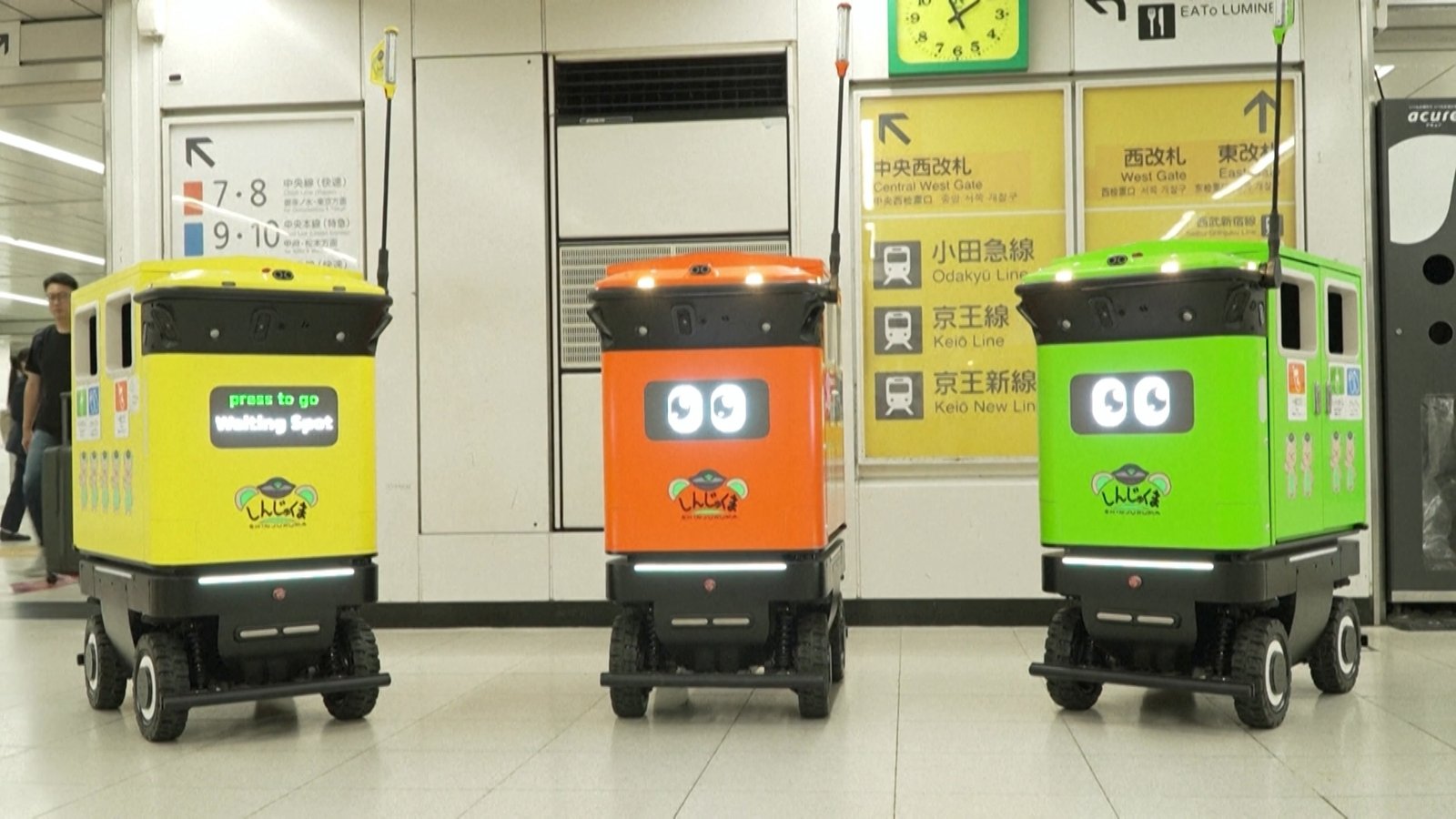
A new type of robotic cleaner is being tested at Tokyo’s Shinjuku Station as Japan looks to automation for help with routine sanitation work.
East Japan Railway Company is testing mobile rubbish bins that can move through the station instead of remaining in one fixed location.
The goal is to determine whether the machines can safely collect waste in one of the busiest railway environments in the world.

Heavy Workload for Cleaning Staff
Waste collection is a frequent task at Shinjuku Station.
In one section operated by JR East, workers manually empty rubbish bins more than 10 times each day.
With huge numbers of passengers passing through the station, maintaining clean facilities requires continuous attention.
JR East research official Shinya Kawamichi said the company is testing how effectively and safely mobile robots can function in such an environment.
Crowded Station Creates a Major Test
The robots face a different challenge from machines operating in controlled industrial environments.
Shinjuku is filled with moving passengers, changing pedestrian flows and tight spaces.
The robotic bins must therefore be able to move without colliding with people or obstructing commuters.
Safety is a major part of the experiment.
JR East also needs to establish whether the robots can reliably identify where rubbish needs to be collected and perform their tasks without disrupting normal station operations.
Technology Meets Labour Challenges
Japan has been increasing its use of robotics and automation as it deals with labour shortages and an ageing population.
The technology is already being explored across industries for repetitive and physically demanding tasks.
The Shinjuku trial applies that approach to railway sanitation.
Rather than replacing workers outright, mobile rubbish bins could potentially support cleaning teams by taking over some routine collection duties.
What Happens Next?
The trial will help JR East determine whether mobile robotic bins are practical for large transport facilities.
If the technology performs well, similar systems could eventually be considered for other busy public spaces.
For now, the Shinjuku experiment is providing a real-world test of how autonomous robots can share crowded environments with people.