



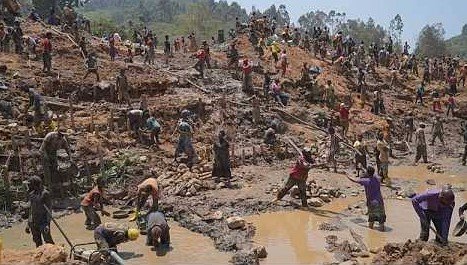
Artisanal miners in the eastern Democratic Republic of Congo (DR Congo) are persisting in their gold mining activities despite the escalating threat of Ebola, as poverty and displacement leave them with limited survival options.
In Iga-Barrière, miners are torn between the necessity of earning money for essentials and the risk of contracting a rapidly spreading virus.
Earning merely a few dollars a day, many miners are internally displaced individuals who have escaped years of conflict and now rely on small-scale mining to sustain themselves and their families.

Miners Face Challenges Amid Ebola Crisis
Miner Mechac Ngadjole Katavara has lost 13 family members and is finding it difficult to access medical care and vaccination.
“The authorities are uncertain about managing the Ebola outbreak,” Katavara noted, mentioning a lack of disinfectants and other basic protective resources.
“We are displaced by war, making life challenging, which is why we continue working under these conditions,” he explained.
Another miner, Daniel Ndjalenga Musingo, has been working at the Iga-Barrière mine for about a month. He maintains distance from other miners and avoids handshakes due to the disease’s spread in neighboring areas. Musingo advocates for an Ebola treatment center closer to the mining site, as patients currently face long journeys to receive medical care.
“Patients die on their way to Bunia. If there was a nearby Ebola treatment center, people could get timely care and recover,” he stated.
Mining Complicates Ebola Containment
Artisanal gold mining depends on a highly mobile workforce. Miners often move between remote sites and population centers in search of gold and to trade. This mobility complicates efforts for health officials aiming to identify infected individuals, trace contacts, and curb further transmission.
Community mistrust and misinformation have also hindered the Ebola response, although many miners acknowledge the virus’s dangers. According to a 2024 report by the Organisation for Economic Co-operation and Development (OECD), about two million people are involved in artisanal and small-scale mining in DR Congo. Gold, coltan, tin, and tungsten are key minerals extracted from the country’s conflict-ridden and economically challenged eastern region.
Poverty Drives Risk-Taking
For many miners, the dilemma is not merely about choosing between work and safety. Esperance Acheni Nyango from Ladile shared that her community faces significant casualties. Despite her fears of Ebola, she continues working to provide for her children and pay rent.
“If I can earn even 10,000 francs ($4.36) for my children to eat, it makes a difference,” she said.
Her plight highlights the harsh realities for many in eastern Congo, where conflict, displacement, poverty, and disease leave vulnerable populations with limited choices.
Vaccination Efforts and Health Response Intensify
Health authorities and international partners are ramping up efforts to control the outbreak, with vaccine supplies beginning to arrive. A shipment of 16,250 doses recently reached N’djili International Airport in Kinshasa as part of the anticipated 70,000 doses provided by the World Health Organization and its collaborators.
More vaccines are expected as vaccination drives and other response actions expand. However, ongoing movement among miners and other residents in affected communities continues to pose a significant challenge.
For people like Katavara, Musingo, and Nyango, survival remains their immediate concern. Until safer economic options and accessible healthcare become available, many are likely to keep returning to the mines despite the risks posed by Ebola.