


France and South Korea are moving to strengthen their strategic relationship, with new agreements covering defence, military information, artificial intelligence, semiconductors, nuclear energy and bilateral trade.
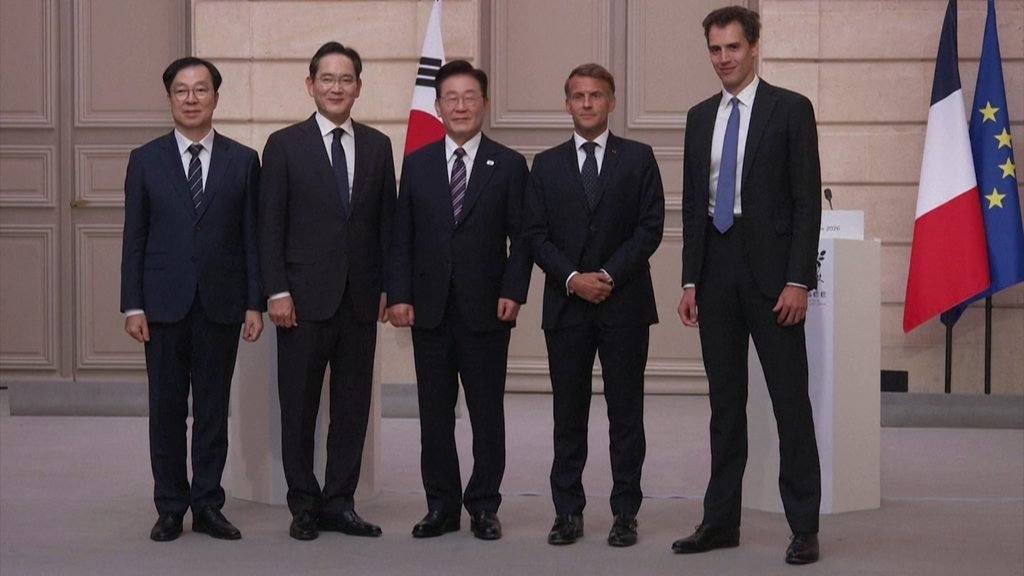
The latest commitments were announced after French President Emmanuel Macron hosted South Korean President Lee Jae Myung at the Élysée Palace in Paris on Tuesday.
The summit came as the two countries marked 140 years of diplomatic relations and sought to give their longstanding relationship a stronger strategic and economic dimension.

A major outcome of the meeting was an agreement on the protection and exchange of military information. The arrangement is expected to support closer defence cooperation between the two countries.
France and South Korea are also preparing to work towards a military logistics support agreement that would improve the practical coordination and stability of cooperation between their armed forces.
The two countries intend to identify defence projects that can bring together France’s technological capabilities and South Korea’s industrial and manufacturing strength.
Trade and technology featured prominently in the discussions. South Korea has set a goal of lifting annual bilateral trade with France to $20 billion by 2030.
Seoul and Paris also plan to intensify cooperation in areas regarded as strategically important, including artificial intelligence, semiconductors and quantum technology.
Joint research and development initiatives are expected to support the technology partnership and create opportunities for companies in both countries.
One example is the emerging relationship between Samsung Electronics and French AI company Mistral AI. Samsung is set to become a strategic investor in Mistral AI, while both companies will collaborate on an AI model for Samsung.
Part of that collaboration is aimed at safeguarding sensitive information linked to semiconductor technology, highlighting the growing importance of AI and chip security to both countries.
Nuclear energy is also becoming a significant area of cooperation. France and South Korea agreed to explore work on next-generation reactors and efforts to diversify nuclear-related supply chains.
They are considering joint research involving nuclear power plants, including small modular reactors, as well as establishing a high-level dialogue focused on civil nuclear energy.
The leaders also addressed international security issues, particularly the Korean Peninsula and the Middle East.
President Lee said the two countries would continue working to support freedom of navigation through the Strait of Hormuz. Macron, meanwhile, reiterated France’s commitment to peace and stability on the Korean Peninsula.
The expanded partnership reflects an effort by France and South Korea to build stronger economic and strategic links at a time of increasing geopolitical competition.
With their cooperation extending across defence, technology, energy and commerce, both countries are seeking to turn 140 years of diplomatic relations into a more practical partnership capable of generating investment, innovation and strategic resilience.