



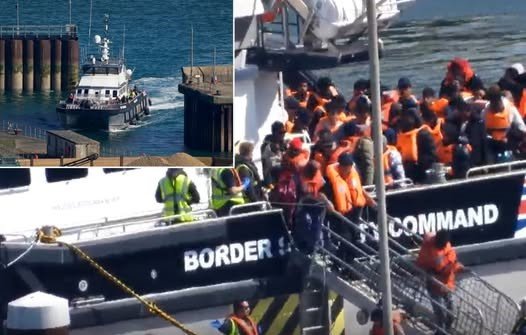
People-smuggling gangs are adapting to increased enforcement along the French coast by using fewer but much larger boats to move migrants across the English Channel, according to a BBC investigation.
The shift has emerged as French authorities step up efforts to prevent vessels from launching, with officers saying they are intercepting a large proportion of attempted crossings before the boats leave the shoreline.
With the supply of smaller dinghies reportedly becoming more limited, criminal groups are said to be combining their operations and loading larger numbers of migrants onto individual vessels.

A recent incident illustrated the scale of the new approach. A 15-metre inflatable boat carrying approximately 230 migrants was seen heading towards Britain, attracting widespread political and media attention.
Authorities and emergency services are particularly concerned about the safety implications. Larger boats carrying hundreds of people can become difficult to control, while mechanical problems, fires or rough conditions could result in mass-casualty incidents.
The danger was highlighted when approximately 170 migrants were rescued on 4 August after their boat caught fire while crossing the Channel.
Smuggling prices have also reportedly increased as opportunities to cross become more limited. Migrants are now being charged as much as €2,000 each, compared with approximately €1,300 last year.
Sources familiar with the criminal networks said passengers are increasingly required to pay in cash before departure. The practice is believed to be intended to prevent people from backing out after paying for a place.
The developments come as Britain and France announce plans to increase police deployments along the French coastline. The two countries are seeking to disrupt the organised criminal networks behind the crossings while reducing the number of dangerous journeys.
The situation has created a new dilemma for authorities. A successful crackdown on the supply of small boats may be forcing smugglers to consolidate operations, potentially resulting in fewer crossings but much larger and more heavily loaded vessels.
For migrants, the consequences could be severe if these increasingly crowded boats encounter trouble in the Channel.