



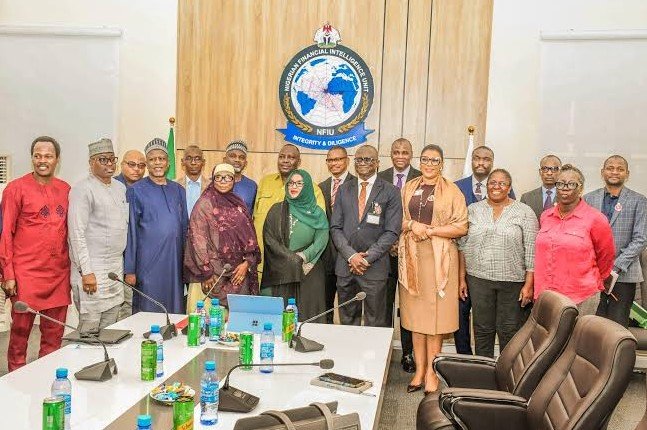
The Nigerian Financial Intelligence Unit (NFIU) has discovered a growing trend in the use of crowdfunding networks for financing terrorist activities in Nigeria. These networks exploit bank accounts and SIM cards, sometimes belonging to deceased individuals, to move funds.
The agency’s findings, detailed in the NFIU’s 2025 Annual Report, reveal that terrorist financiers are also utilizing women’s bank accounts and third-party phone numbers to obscure their financial transactions.
The report highlights how foreign-based facilitators launch social media campaigns disguised as humanitarian or educational efforts. They use encrypted messaging platforms like Telegram and Signal to spread links directing sympathizers to payment platforms and bank accounts. Many supporters may make small contributions ranging from $50 to $500, collectively accumulating significant funds without triggering anti-money-laundering systems.

These amassed donations are then consolidated into a main account managed by a network member living abroad. Once the funds reach a certain level, they are dispersed further.
The NFIU notes that the money is then divided into smaller amounts and sent via International Money Transfer Operators (IMTOs) and remittance apps to money mules in Nigeria, which include students, small-business owners, and relatives. This fragmentation complicates tracking by financial institutions and investigators.
Recipients can convert these funds into cash or use them to buy items with legitimate or operational uses like motorcycles and internet equipment. The money could be transferred again through mobile banking to supply logistics for field operations.
The report also highlights the use of women’s accounts as proxies. Accounts opened under women’s names can be controlled by male counterparts in charge of logistics or command roles. In many cases, women might be unaware of the transactions occurring through their accounts.
Additionally, there is the issue of using unregistered or third-party SIM cards linked to bank activities, making it harder for authorities to trace transactions back to their origins.
Specific attention is given to financial transactions linked to terrorist groups such as ISWAP. These groups reportedly use coded transaction descriptions and switch languages to evade detection by automated systems.
Beyond terrorism financing, the report outlines a broader scope of financial crimes involving technology and cross-border transactions. Fraudulent practices like Ponzi schemes, cryptocurrency scams, and other digital frauds are on the rise, with criminals exploiting vulnerabilities in fintech systems.
The report concludes with concerns over the management of public funds, pointing out the risks associated with such funds being vulnerable to misuse in this complex financial crime landscape.